


Our Investment in Star Catcher
The First Power Grid in Space
We’re excited to partner with Andrew Rush, Michael Snyder, Bryan Lyandvert, and the Star Catcher team as they build the missing infrastructure layer for the orbital economy: power.
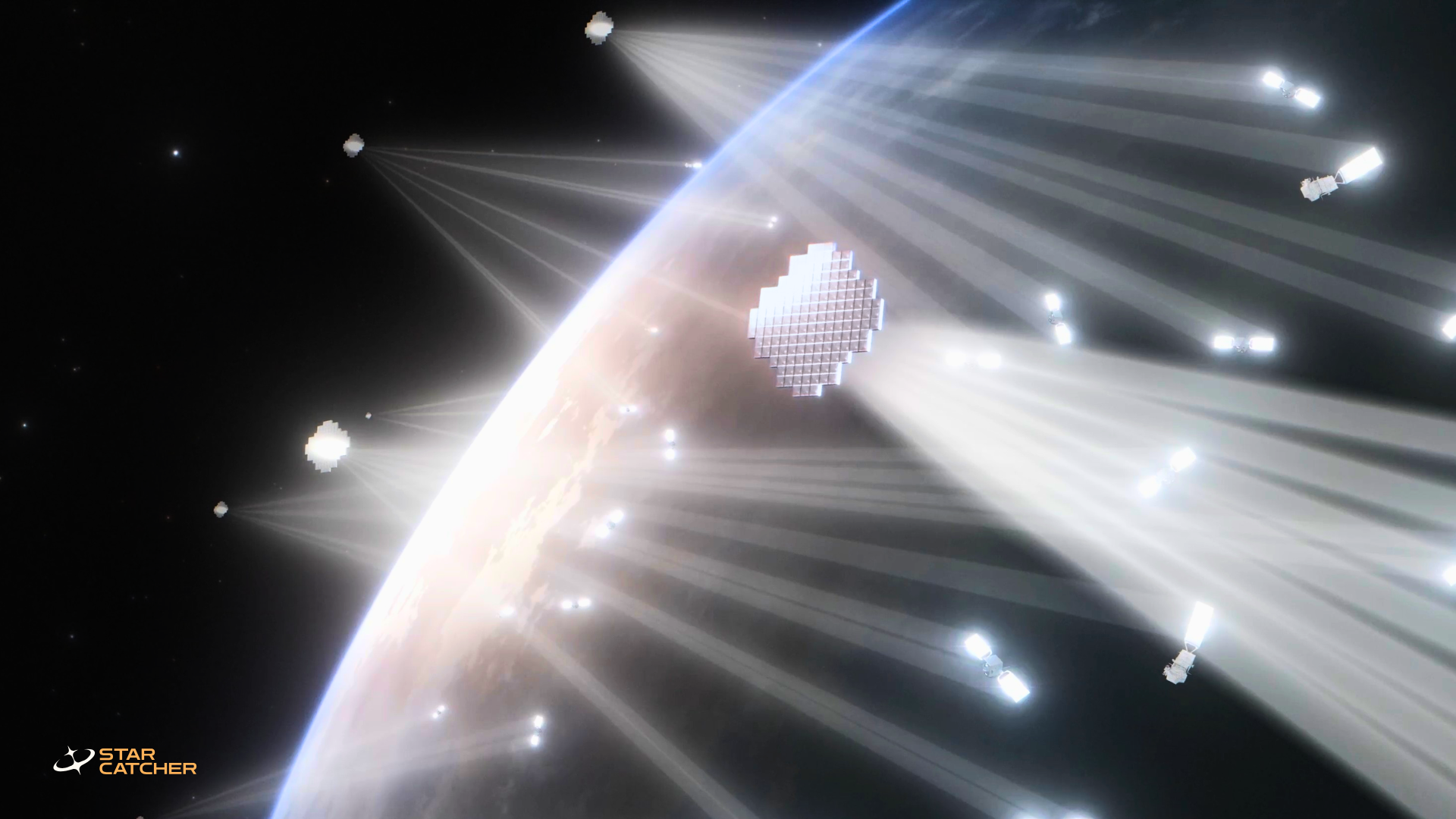
Star Catcher is building a space-based energy grid: a network of Power Nodes that collect solar energy and beam it directly to the existing solar arrays on satellites. No retrofit. No new receiver hardware. Just scalable, on-demand power for spacecraft is increasingly constrained by what they can generate themselves.
The simple idea: space already has rockets and communications. Now it needs electricity.

The Missing Grid Above Earth
Every major leap in human productivity has followed infrastructure. Transportation unlocked trade. Communications connected markets. Energy-powered industrialization, cloud computing, and AI.
Space is following the same path. Reusable launch has made orbit more accessible. Communications infrastructure connects satellites to Earth and to each other. But there is still no power grid in space.
That gap is now impossible to ignore. Satellites are being asked to support direct-to-cell, imaging, orbital compute, defense, sensing, maneuvering, and edge AI. Yet power remains one of the hardest constraints in spacecraft design. In low Earth orbit, satellites spend meaningful time in eclipse, operate within fixed solar and battery budgets, and make painful trade-offs across payload uptime, bandwidth, compute, thermal load, and mission life.
The industry is no longer limited by imagination. It is limited by watts.
From Bigger Satellites to Shared Power
The old answer was simple: add more solar panels and batteries.
But in space, more power means more mass, more complexity, higher launch costs, and greater design compromises. For many missions, the spacecraft becomes a power plant with a payload attached.
Star Catcher offers a different model. Their Power Nodes collect sunlight, concentrate and condition that energy, and beam it to customer satellites using optical power beaming. Because client satellites can receive that power through existing solar arrays, Star Catcher is not asking the industry to redesign every spacecraft. It is giving satellites already in orbit and those being designed today access to more energy from the outside.
Most space companies are trying to build better satellites. Star Catcher is building the grid they will plug into.
Why This Moment Belongs to Star Catcher
Three shifts make this urgent now.
First, orbital demand is compounding. Demand is rising from 10,000-plus satellites needing 50-plus megawatts today to a projected 60,000-plus satellites needing gigawatt-scale energy by 2030.
Second, new applications are power-hungry by default. Direct-to-cell needs more power to close the link budget. Earth observation needs more duty cycle. Defense missions need persistence and resilience. Orbital data centers need an entirely different power envelope.
Third, the customers are ready to go, and the pull is already visible. Star Catcher has already signed seven commercial Power Purchase Agreements with customers, including Loft Orbital, Starcloud, and Astro Digital, and their technology has gained broad interest across defense, telecom, sensing, in-orbit operations, and orbital infrastructure.
This is not a science project looking for a market. It is a market waiting for the missing utility layer.
The Team Has Already Built the Future Once
We love hard infrastructure companies founded by people who have already shipped hard infrastructure. Star Catcher is exactly that.

Andrew Rush, CEO, previously led Made In Space, the in-space manufacturing company that pioneered orbital 3D printing (acquired by Redwire), and later served as Redwire’s founding President and COO. He brings the scar tissue of building real space hardware, selling to government and commercial customers, navigating policy and procurement, and turning technical ambition into an operating company.

Michael Snyder, CTO, is the technical center of gravity. He worked with Andrew at Made In Space and Redwire, served as Made In Space’s Chief Engineer and Redwire’s CTO, has flown more than a dozen payloads to space, and holds more than 50 patents across space technologies. Star Catcher’s challenge is not one invention. It is systems integration: collection, transmission, tracking, thermal behavior, orbital dynamics, customer integration, and network economics.

Bryan Lyandvert, CBO, brings the capital formation and market-building muscle from Amazon's emerging technology group, MetaProp Ventures, and space investing.
This is the kind of team you need for a company like this: technical enough to make the physics work, operational enough to get hardware to orbit, and commercial enough to build a category before the category has a name.
The Utility Layer for the Orbital Economy
Star Catcher is still early. The hardest work remains ahead. But the company has already conducted a public ground demo of their end-to-end architecture, validated on-orbit tracking and client acquisition software, and completed a multi-kW, kilometer-scale ground-beaming test.

The next milestones matter: the first orbital power-beaming demonstration, scheduled to launch later this year, followed by a series of in-space demonstrations that will build toward an operational, scalable power grid in space.
If space is going to become a real economic domain, it needs shared infrastructure. It needs utilities. It needs power that is flexible, persistent, and available beyond what each spacecraft can carry at launch.
Star Catcher gives space companies a new primitive: on-demand energy.
We’re excited to partner with Andrew, Michael, Bryan, and the Star Catcher team as they build the first power grid in space, and help turn orbit from a collection of constrained machines into an electrified, shared, scalable economy.
Related Posts

